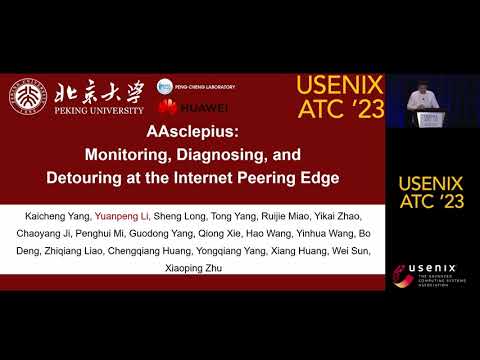
AAsclepius: Monitoring, Diagnosing, and Detouring at the Internet Peering Edge
summary
AAsclepius automates detection, localization, direction identification, and detouring of middle faults at the peering edge for Huawei Cloud. It probes representative IPs (representative IP per /24) and reports ASes with sustained loss (>3 minutes), classifies faults with a decision tree, uses PathDebugging by probing alternate POP-to-POP paths over a private backbone to tell outbound vs inbound, and programs BGP to detour outbound traffic. Deployed for ~2–3 years, it diagnoses thousands of faults, circumvents >200 middle faults, and typically restores loss within ~8 minutes, with detours reducing packet loss by up to 7% on average.
AI-written summary · about
chapters (9)
- 0:00AAsclepius overview and peering issues
- 1:08Reducing packet loss rate
- 2:55Network fault classification
- 5:03Automated fault detection and detouring
- 6:27Monitor subsystem: Active probing
- 9:22Diagnosing subsystem: Fault localization
- 14:22Detouring strategies
- 16:35Performance evaluation
- 19:48Conclusion
related talks
 24mHarp: Improving VPC Network Availability via Efficient Failure Detection and Rerouting...
 23mAutomatic Traffic Scheduling for Internet Connectivity Failures
 16mAres: Comprehensive Path Hijacking Detection via Routing Tree
 21mDiagnosing Application-network Anomalies for Millions of IPs in Production Clouds
 32mActive Fault Finding in Networks
 14mSkyline: A Cloud Centric Internet Monitoring Engine
 15mCost-effective and Reliable Global Internet Peering with Programmable Switches
 29mNetwork Fault Finding System: Packet Loss Triangulation