MatrixKV: Reducing Write Stalls and Write Amplification in LSM-tree Based KV Stores
summary
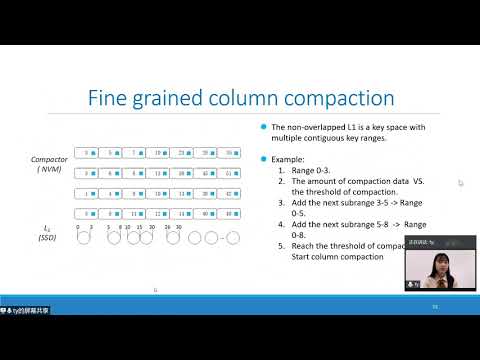
MatrixKV implements a matrix container in NVM (Optane DC PMM) inside RocksDB, adds column compaction and cross-row hint search, and flattens levels to cut write amplification. It reduces each L0→L1 compaction to about 33 MB compaction (vs ~3.1 GB in RocksDB and 15 GB in NoveLSM), lowers write amplification by ~3.4×, and delivers 3.6×/2.6× higher random write throughput and 5×/1.9× lower 99th‑percentile latency compared to RocksDB and NoveLSM.
AI-written summary · about
chapters (17)
- 0:00Intro
- 0:31Outline
- 1:56Challenge 1: Write stall
- 3:29Root cause of write stall: LO-L1 compaction
- 5:27Root cause of increased write amplification
- 7:10Motivation
- 8:02Overall Architecture
- 9:12Matrix Container
- 10:21Row Table
- 11:10Fine grained column compaction
- 13:19Reducing LSM-tree depth
- 14:08Cross-Row hint search
- 16:01Evaluation Setup
- 16:37Random Write Throughput
- 17:25Write stalls
- 17:59Tail Latency
- 18:25Fine granularity column compaction
related talks
 12mSpanDB: A Fast, Cost-Effective LSM-tree Based KV Store on Hybrid Storage
 18mSplitKV: Splitting IO Paths for Different Sized Key-Value Items with Advanced
 18mPreview: KV-Stores and Databases
 15mKVIMR: Key-Value Store Aware Data Management Middleware for Interlaced Magnetic...
 15mMitigating Resource Usage Dependency in Sorting-based KV Stores on Hybrid...
 13mClosing the B+-tree vs. LSM-tree Write Amplification Gap on Modern Storage Hardware...
 13mDifferentiated Key-Value Storage Management for Balanced I/O Performance
 05mExploring Data Deduplication in LSM Tree-based Key-Value Stores (Work-in-Progress Report)