The Conscious Turing Machine (CTM), a formally defined Theoretical model of Consciousness

summary
A formally specified Conscious Turing Machine is given as a 7‑tuple with roughly 10 million processors, a 10‑Hz clock, STM/LTM, an up‑tree competition and down‑tree broadcast; processors create 5‑tuple chunks (processor, time, gist up to eight words, weight) forming a self‑defined language Brainish. A proved property makes the winner‑take‑all tournament give each chunk win probability proportional to its weight. Weights adapt via a sleeping‑experts mechanism; concrete numbers (H≈24, 2^34 ticks ≈64 years) yield testable predictions about binding and two distinct pain‑asymbolias.
AI-written summary · about
chapters (14)
- 0:00Introduction
- 1:48Setting the stage
- 4:43Blum’s consciousness curiosity
- 8:47CTM model explained
- 12:26Processing sensory input
- 17:25First Brainish words
- 20:00CTM architecture defined
- 24:03Winner-take-all competition
- 29:10Chunk weights and honesty
- 32:08Conscious attention problem
- 33:12Phenomenal consciousness
- 37:27CTM axioms and experience
- 41:04Pain asymbolia and self
- 43:37Summary of CTM
related talks
 01h 14mAI Consciousness is Inevitable: A Theoretical Computer Science Perspective
 47mWhat is Consciousness and Can Machines have it? Part 1
 59mCal Day Lecture: Can a Machine be Conscious? Towards a Conscious AI
 16mWhat is Consciousness and Can Machines have it? Part 2
 01h 18mTowards a Conscious AI
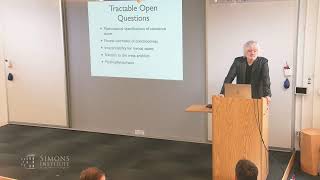 53mConsciousness and Large Language Models
 21mSentient AI – Can We Create Artificial Consciousness?
 21mNeural Turing Machines: Perils and Promise