Homomorphic Commitments & Signatures
summary
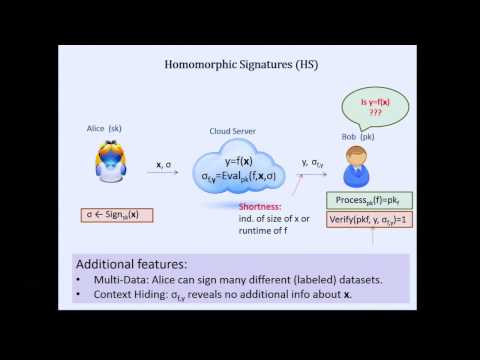
Constructs homomorphic signatures for arbitrary circuits (leveled) where certificate size depends on circuit depth but not data size, built from equivocable homomorphic commitments derived from GSW-style homomorphic ops and LWE/SIS trapdoors. Setup uses a long public random string; signing is trapdoor-based equivocation, verification runs a homomorphic evaluation on public commitments then checks a short opening. Scheme achieves selective security and extensible fixes (chameleon hashes, ZK), but needs heavy preprocessing and lacks bootstrapping.
AI-written summary · about
chapters (13)
- 0:00Intro
- 0:44Recall the GSW FHE
- 3:47Homomorphic Computation on Commitments and Openings
- 15:01SIS Trapdoor with Correct Distribution [GPV08, MP12, LW15]
- 17:13Summary: Homomorphic Commitments
- 18:37Homomorphic Signatures: Motivation
- 20:16Homomorphic Signatures (HS)
- 24:58Constructions of Homomorphic Signatures
- 27:50Other Solutions
- 31:11Warm-Up: 1-Time, 1-Bit Signature
- 32:33Warm-Up: 1-Time, Multi-Bit Signature
- 37:45Extensions
- 39:25Open Problems
related talks
 01h 07mHomomorphic Signatures and Pre-Processing NIZK
 01h 04mFully Homomorphic Encryption II
 45mFully Homomorphic Encryption I
 01h 00mFunctional Commitments
 23mBootstrapping Homomorphic Encryption via Functional Encryption
 01h 03mLockable Obfuscation
 01h 07mLattices and Encrypted Computation
 30mStateful Hash based Signatures: Practical Enhancements and Lessons learned