Historical Talk on Lattice-Based Cryptography
summary
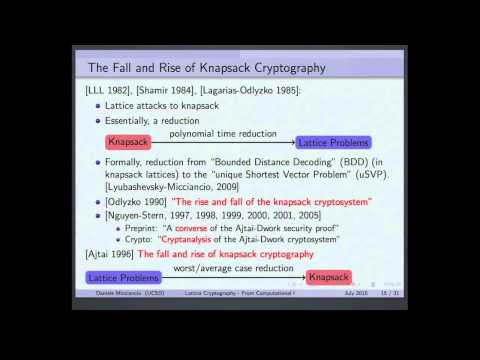
Ajtai’s 1996 paper introduces a worst-case to average-case reduction for lattice problems and spawns the SIS/LWE reductions that underpin modern schemes; 1998 shows NP-hardness for SVP and LLL-based attacks break many knapsack proposals. Practical advances shrink keys from quadratic matrices to structured, cyclic/anti-circulant lattices using FFT/NTT so storage is near-linear and speeds match SHA-2; small moduli (≈16-bit) suffice. Regev gives a quantum reduction linking injective LWE to worst-case lattices, and Gentry’s 2009 FHE exploit LWE variants for bootstrapping.
AI-written summary · about
chapters (18)
- 0:00Intro
- 4:54What are Lattices
- 5:43History of Lattices
- 7:36The Importance of the Problem
- 11:32Discrete Log
- 12:54Discrete Log Proof
- 15:01Lattice vs Discrete Log
- 17:37Solution
- 19:37Hardness
- 23:03Chinese remainder theorem
- 29:40subsetsum
- 31:40knapsack
- 35:30the Curie lattice
- 37:19periodic modulo Q
- 48:31shortcomings
- 51:33cryptography in lattice
- 52:46survey talk
- 56:08open problems
related talks
 39mLattice Based Cryptography Primer
 01h 04mThe Mathematics of Lattices II
 40mPost-Quantum
 01h 08mThe Mathematics of Lattices I
 57mAlgorithms for Lattice Problems, in Practice
 01h 15mAlgebraic Lattices and Ring Learning with Errors
 01h 04mUsing Lattices for Cryptanalysis
 01h 07mLattices and Encrypted Computation