Graph-Induced Multilinear Maps from Lattices
summary
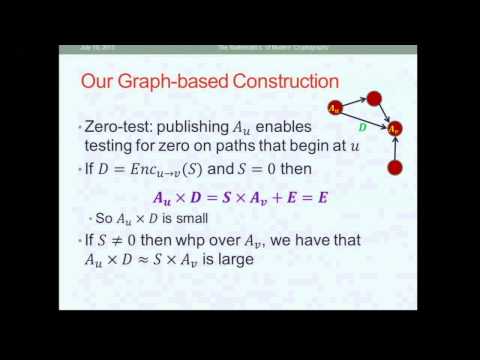
Construction gives multilinear maps built from standard lattice/LWE ingredients that encode secrets as small matrices and lets multiplication only along prescribed paths: graph controls which multiplications are allowed. Key result: private-encoding N-party non‑interactive key agreement works using chains, but public encodings remain fragile. Main attack: two or more encodings of zero concatenate to produce a working trapdoor that breaks LWE instances. Mitigations include randomized similarity transforms (safeguards) and using large cyclotomic rings with levels; these harden but do not yet have full reductions.
AI-written summary · about
chapters (12)
- 0:00Intro
- 0:23Multilinear Maps (MMAPs)
- 2:00Previous MMAP Constructions
- 3:29Two "Modes" of Using MMAPS
- 9:19Graph-Induced MMAPS
- 14:13Application: Non-interactive Multipartite KA
- 14:38Non-interactive Multipartite KA From Graph-Based MMAPS
- 16:52Application to Obfuscation
- 24:12Our Graph-based Construction
- 34:48Who Can Encode?
- 36:18A Commutative Variant
- 50:45Conclusions and Future Work
related talks
 01h 29mLattices, Multilinear Maps and Program Obfuscation
 01h 00mMultilinear Maps and Attacks I
 01h 07mLattices and Encrypted Computation
 57mTutorial: Encrypted Computation from Lattices
 51mMultilinear Maps and Attacks II
 57mLattice Assumptions with Hints: Succinct LWE and its Applications
 01h 06mObfuscation: Past, Present, and Possible Futures
 01h 04mThe Mathematics of Lattices II