How We Survived (and Thrived) During The Pandemic and Helped Millions...
summary
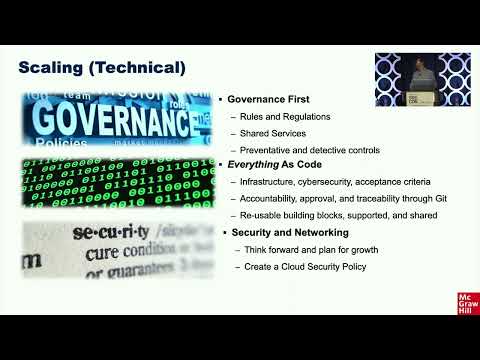
Company runs 80+ dev teams, 400+ apps and 100s of services across 150+ AWS accounts and 4,000 EC2 instances and absorbs a pandemic-driven spike with 100k new students without hiring extra ops staff. Preparation centers on Upstream Thinking: move to per-team accounts, strict governance and automated guardrails, AMI bakery with 30-day rotation, everything-as-code and shared Terraform modules, and a hub-and-spoke transit gateway plus DNS internalization that cuts public APIs by ~30%. Automation also reclaims cost (hundreds of thousands saved) and removes 100k stale snapshots.
AI-written summary · about
chapters (16)
- 0:00Intro
- 0:32About McGraw Hill
- 2:21Covid-19 Response by Numbers
- 3:22Think Upstream
- 4:28Evolution to Multi-Account and Multi Cloud Architecture
- 7:12Scaling (Non-Technical)
- 9:41Scaling (Technical)
- 14:35Dev+Sec+Ops
- 17:46Unified Network
- 19:51McGraw Hill's Cloud Fabric
- 21:06Cloud Adjacency
- 24:13DNS Internalization (Solution)
- 25:13Guardrails and Security Controls
- 27:55Cost Management
- 30:00Demo - Monitoring as Code
- 31:19Horizon
related talks
 31mDevOps in the Cloud: Case Studies of Amazon.com teams and their resilient architectures
 48mDevops@Scale
 29mSoftware is now Saving the World (or at least helping)
 55mDevOps @Scale (Greek Tragedy in 3 Acts)
 29m20x your high-performing agile delivery team
 38mBuilding a Cloud Native Culture in an Enterprise - Deep Kapadia & Tony Li
 13mScaling for a Pandemic: How We Keep Ahead of Demand for Google Meet during COVID-19
 44mDevSecOps: Balancing Agility, Security & Stability in a Continuous Software Business