Keynote - Rust: confident, productive systems programming

summary
Rust claims that its ownership model gives memory safety without garbage collection, and guarantees no data races via the borrow checker. Examples: a C++-style vector aliasing bug is prevented by move/borrow rules; split_at_mut uses a small audited unsafe core to return two mutable slices safely; channels move ownership; Mutex returns a guard that releases on drop. Tooling and process include cargo, Rayon for data-parallel iterators, nightly/beta/stable release channels and RFCs for controlled evolution, and Servo components already landing in Firefox.
AI-written summary · about
chapters (18)
- 0:00Intro
- 3:43Why Mozilla?
- 5:46What is control?
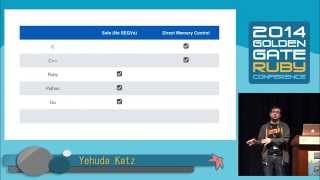
- 8:46What is safety?
- 14:13Ownership in Rust
- 18:17Compiler enforces moves
- 22:23Mutable references
- 27:01Borrow checking
- 28:22Bending the rule
- 31:14Concurrency in Rust
- 41:57Static checking for thread safety
- 44:11Abstraction in Rust
- 44:41Defining a trait
- 45:21Using a trait
- 46:59"Zero cost" abstraction
- 47:58Leveraging abstraction
- 49:01Rust 1.0: Stability as a deliverable
- 53:10The feature pipeline