"Rust in Legacy Regulated Industries"
summary
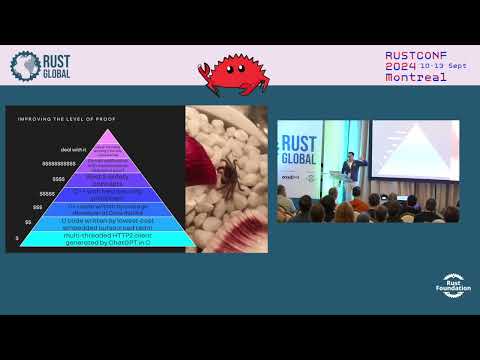
Ampere (Renault Group) mandates Rust at exposed network interfaces and reports that after two years more than half of in-car software components are Rust, with about 100 people working on Rust full-time. The migration removes proxies and packet-inspection layers, yielding measurable savings in performance, energy, and technical debt, and claims roughly 70% fewer memory safety vulnerabilities. Remaining friction includes Android buildchain limits (no Cargo, using Sun), crate supply-chain concerns, and gaps in safety-qualified toolchains for embedded certification.
AI-written summary · about
chapters (9)
- 0:00Rust in legacy regulated industries
- 2:01Challenges in regulated software
- 3:13Rust benefits for car makers
- 5:55Rust adoption strategy
- 9:00Friction points and supply chain
- 11:18Expanding Rust to safety-critical
- 13:51Rust versus other safety
- 15:50Safety-critical Rust integration
- 16:41Future of Rust in regulated
related talks
 07mLightning Talk: “How Rust Is Steering Automotive Software Toward Safety”
 56mRust for Safe and Scalable Automotive: Insights from
 40mRust for large-scale automotive applications
 56mWhen to Choose Rust
 12mLightning Talk: Rust Will Solve All Your Problems, Possibly. Arm’s Journey to Using...
 26mIntroducing Rust into a Legacy Embedded System
 56mRust for Foundation Software
 40mWhat's up with Rust?