2D ARIMA, Capturing New Trends for Distant Time Horizons
summary
Two-Dimensional ARIMA is a concrete method that pivots cohort-by-age revenue into a matrix and applies an iterative column-wise ARIMA so each predicted month feeds the next, capturing rapid trend shifts and long horizons. Evaluated on three internal apps (3 years) and a public 4‑year dataset against ARIMA, Prophet and XGBoost, it yields consistently lower MAE and steadier relative errors as horizon grows, with much slower error inflation. It tolerates tens–hundreds of samples, runs fast, but needs imputation for sparse starts and risks early error propagation.
AI-written summary · about
chapters (9)
- 0:00Introduction and context
- 3:16Business context at Lightricks
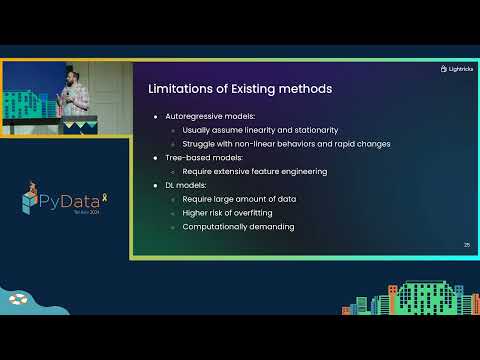
- 7:10Limitations of existing models
- 9:22Requirements for new model
- 11:092D ARIMA model explained
- 15:34Model evaluation results
- 18:49Advantages and limitations
- 20:38When to use the model
- 21:00Q&A
related talks
 01h 40mApplied Time Series Econometrics in Python and R
 41mReliably forecasting time-series in real-time
 29mMachine Learning: Better than Traditional Techniques?
 01h 26mApplying Statistical Modeling & Machine Learning to Perform Time-Series Forecasting
 42mRobust Automated Forecasting in Python and R
 29mTime Series Forecasting Techniques in Python
 29mARCH-GARCH Models Tour
 01h 43m(Serious) Time for Time Series