Over- and Under-Estimation of Vaccine Effectiveness
summary
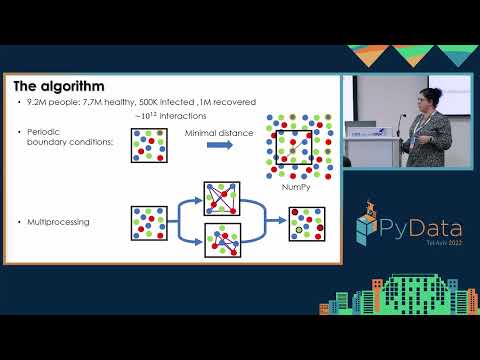
Claim: failing to account for indirect protection skews vaccine effectiveness estimates. Builds a heterogeneous infection model in Python with periodic boundary and multiprocessing, fits to public Israeli data across 1,600 statistical areas, and forces household-heavy transmission (≈50% inside household). Varies community mixing and study design, shows low mixing produces overestimated VE and high mixing underestimates it, reproduces cases and recovers the input 85% true VE in a targeted population-based estimator.
AI-written summary · about
chapters (10)
- 0:00Physics to epidemiology
- 3:35Individual-based infection model
- 7:50Optimizing large-scale simulations
- 9:38COVID-19 real-world applications
- 11:03Vaccine effectiveness discrepancies
- 13:29Mixing hypothesis with networks
- 16:18Model validation with Israeli data
- 20:58Correcting population bias
- 22:21Collaborations and future work
- 23:25Q&A
related talks
 30mDisease Modeling with Scipy and PyMC
 43mProbabilistic Models for Pathogen Evolution Within and Between Hosts
 31mBayesian Risk Analysis For Large Multi-Modal Data
 53mAre We Measuring the Right Thing? Distribution Shift Lessons for Federated Learning
 46mModeling the Evolution of Within-host Reproductive Rates in Pathogens
 23mWhat cyber security can teach us about COVID-19 testing
 30mPolicy Evaluation under Interference
 37mDid Your Rollout Actually Work?