How distributed representations make chatbots work (at least a bit)
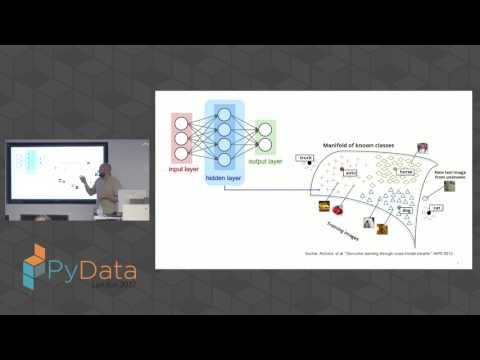
summary
Distributed word vectors produce the actual claim: similar-context words sit near each other so a simple classifier can route queries to content. The pragmatic tools are mean word vector baseline for sentences, pretrained embeddings (Facebook supplies 90→294 languages), and an orthogonal alignment of multilingual embeddings that gives high translation precision (e.g. Russian↔Ukrainian ≈90%). A working prototype combines rules plus embeddings, runs in about 50 lines of Python, needs a few hundred seed dictionary entries for alignment, and can be validated for medical triage with careful thresholds.
AI-written summary · about
chapters (9)
- 0:00Babylon's healthcare vision
- 1:25Primary care doctor workflows
- 3:12Deep learning for language/vision
- 4:16Neural networks learning representations
- 8:56Distributed representations in NLP
- 13:14Chatbot with word vectors
- 23:20Multilingual word vectors
- 31:13Medical chatbot deployment challenges
- 37:48Q&A
related talks
 28m"Embeddings: How Computers Learned to Read"
 41mSemantic Multimodal Multilingual Similarity Engine
 28mByron Galbraith, Chief Data Scientist, Talla at MLconf Seattle 2017
 22mMultilingual embeddings to scale NLP models to multiple...
 32mDistributed Vector Databases - What, Why, and How
 01h 03mWhat comes after ChatGPT? Vector Databases - the Simple and powerful future of ML?
 23mDo Multilingual Embeddings Really Share a Semantic Space?
 27mData with Purpose: The Power of Embeddings