Tricking Neural Networks : Explore Adversarial Attacks
summary
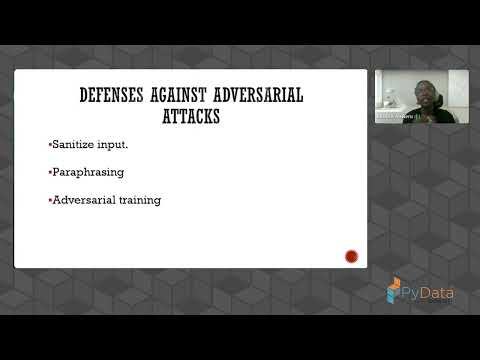
Shows concrete NLP attacks: a sentiment model flips when perfect -> spotless flips sentiment, a translator breaks with imperceptible unicode triggers change translation, and attackers find those tokens via gradient-based white-box attacks. Demonstrates transferability to other models and a plausible impact on finance (Bloomberg GPT cited). Offers defenses that are tested: input sanitization and adversarial training (works but is computationally expensive).
AI-written summary · about
chapters (9)
- 0:00Introduction
- 1:11Adversarial attacks defined
- 3:01Adversarial vision demo
- 4:09NLP adversarial attacks
- 6:18Generating attacks with gradients
- 9:31Why attacks matter
- 11:35Defending models
- 14:01Key takeaways
- 15:46Q&A
related talks
 25mTricking Neural Networks : Explore Adversarial Attacks
 38mUsing adversarial samples to robustify your Neural Network Models
 21mAdversarial Attacks
 31mAttacking Deep Learning-Based NLP Systems
 36mAdversarial Attacks on Deep Learning
 35mHacking AI Systems: How to (Still) Trick Artificial Intelligence
 52mSleeping With One AI Open: An Introduction to Attacks Against...
 46mA Short Introduction to Hacking Artificial Intelligence