Private targeting strategies
summary
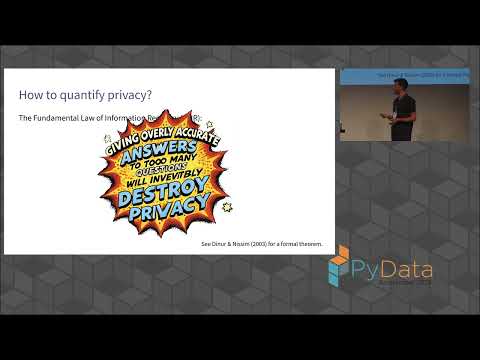
Claims two implementable methods that satisfy differential privacy and quantifies the tradeoff: Private Causal Neural Networks trained with DP‑SGD to estimate uplift, and a randomized targeting policy that flips treatment with DP‑calibrated probability. Simulation benchmarks (10k, 100k, 1M samples) show Epsilon 0.05 shrinks CATEs to near‑random profits, Epsilon ≈1 recovers utility close to nonprivate, larger samples restore performance, and a field experiment with over 400,00 customers validates the privacy versus profitability curve and provides a runnable notebook.
AI-written summary · about
chapters (11)
- 0:00Private targeting intro
- 5:40Profit vs privacy balance
- 8:30Privacy protection limits
- 12:02Differential privacy solution
- 14:09Implementing differential privacy
- 17:00Double ML for uplift
- 22:39Differentially private neural nets
- 27:59Randomizing targeting
- 30:55Benchmarking strategies
- 33:48Key insights and future
- 34:50Q&A
related talks
 01h 14mTutorial: Privacy, Part II
 30mAccuracy First: Selecting a Differential Privacy Level for Accuracy-Constrained...
 31mIs your model private?
 01h 07mLarge-Scale Private Learning, Part II
 26mAaron Roth, Associate Professor, University of Pennsylvania, NYC 2017
 36mTalk by Mahdi Haghifam (Toyota Technological Institute at Chicago)
 21m"SECRETS ARE LIES, SHARING IS CARING, PRIVACY IS THEFT." - A Dive into Privacy Preserving
 01h 02mLarge-Scale Private Learning, Part I