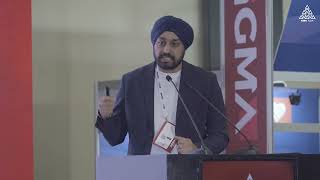
Keynote: Applied NLP in the age of Generative AI

summary
Describes concrete workflows and outcomes: uses spaCy and Prodigy for semi-automated annotation, applies transfer learning to replace LLM prototypes with small task models, and separates grammar-level from business logic. Case studies report 10× faster data development at S&P Global, a distilled component that is 6 MB at 16,000 words/s, and a workshop model that beat GPT baseline 20× faster. Also discusses retrieval-augmented generation, Calendly-style interface tradeoffs, and modular pipelines with multiple production deployments.
AI-written summary · about
chapters (18)
- 0:00Applied NLP with generative AI
- 1:46Why large language models became so popular
- 3:52Generative AI industry challenges
- 5:58Structured output with prompt templates and Spacy M
- 7:23Modular NLP workflows
- 9:50Human-in-the-loop evaluation and transfer learning
- 12:17Refactoring data and schemas
- 16:11Case study extracting recipe ingredients
- 20:02GitLab ticket analysis workflow
- 23:17Refactoring vs retrieval augmented generation
- 26:05Window knocking machine test
- 28:55Why chatbots aren’t always the best solution
- 31:00Best practices for AI paradigms
- 32:03Q&A: human vs model-in-the-loop
- 34:29Taxonomy adaptation in models
- 36:57Handling NLP sub-tasks
- 39:03Transfer learning benefits
- 41:09Refactoring feedback for summarization
related talks
 58mKeynote: The past, present, and future of AI for application developers
 59mKeynote: The past, present, and future of AI for application developers
 44mKeynote: Tracking the Pulse of Generative AI
 11mUnlocking Potential with Generative AI - Keynote Speech
 15mHarnessing the Power of Generative AI for Intelligent Applications
 44mKeynote: Tracking the Pulse of Generative AI
 22mKeynote: Generative AI in Mobile Applications
 10mKeynote: Enterprise Value with Generative AI