Blockchain as Regulatory Technology: from Code is law to Law as Code
summary
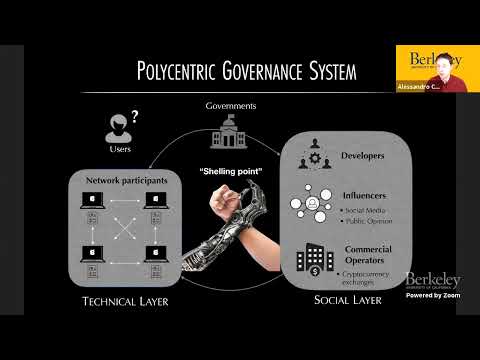
Blockchain systems enforce rules by code, with tamper‑resistance, automated smart‑contract execution, and no single operator who can unilaterally change protocol, which creates a gap between rule of code and legal enforcement. Specific incidents include DAO hack ($150M raised, $50M stolen) leading to fork -> Ethereum Classic and the Parity bug (frozen funds); governance actors span developers, miners, exchanges and mining pools. Regulation options (fiduciary duties for maintainers, coercing exchanges) exist but are hard because of polycentric power. A European Research Council grant (€2M over five years) funds empirical study of on‑chain and off‑chain governance and DAO pilots (DAOstack, Aragon).
AI-written summary · about
chapters (10)
- 0:00Start
- 4:01RULE OF LAW
- 6:09RULE BY CODE
- 7:36CODE IS LAW
- 8:43Outside the purview of the law
- 15:03New POWER DYNAMICS
- 15:20Immutability
- 19:42BLOCKCHAIN GOVERNANCE
- 24:11No BLOCKCHAIN IS AN ISLAND
- 27:13POLYCENTRIC GOVERNANCE SYSTEM
related talks
 01h 01mRegulation through Governance
 13mRethinking Decentralised Governance
 49mCode as Law
 01h 04mRegulatory Incentives Towards Decentralization
 21mAccelerating Growth: Blockchain Integration, DAO's & Fintech Processes
 01h 02mBlockchain is Cyberpunk
 55mBlockchain Ethics Field Building
 12mRegulation in the Blockchain Space: Navigating the Global Landscape