Economic Security of Distributed Systems
summary
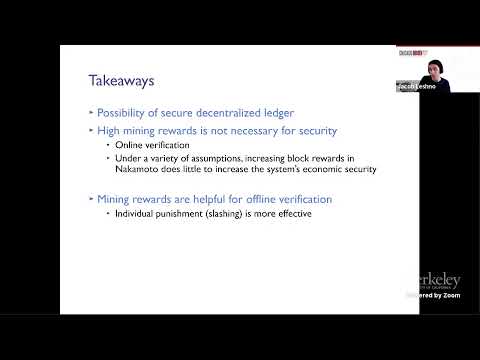
Claims Nakamoto consensus fails an economic-security test: under a rental-hash model an attacker can buy hashes and execute a double-spend attack that is essentially free, and even fixed ASICs don’t fix this because miners can be bribed. Models compare rental vs fixed-capital miners, interest and currency-devaluation effects, and KYC/exchange linkages as ad hoc deterrents. Concrete alternatives include checkpointing / proof-of-stake designs that trade liveness for safety and slashing-backed stake commitments so online-confirmation merchants get real, provable guarantees.
AI-written summary · about
chapters (11)
- 0:00Intro
- 0:42Security of a financial ledger
- 5:34Economic Security in Traditional Payments
- 8:00Underlying Assumption: Agreement on the System
- 13:28Security of Nakamoto - Rental Model
- 20:13Security of Nakamoto - ASICS
- 29:46Security of Nakamoto - Other considerations
- 33:00Security of Nakamoto - What Deters Attacks? - Large miners - pivotal miners need to be paid
- 38:25Safety is Feasible - Alternative Design
- 43:00Safety for Offline Merchants - cost of constructing a false ledger
- 45:02Takeaways
related talks
 56mEconomic and Social Risks Panel
 32mAnalysis of Nakamoto Consensus
 33mByzantine generals: How the blockchain solves the distributed consensus...
 56mA sledgehammer to crack a nut: why blockchain is not (always) a good idea
 01h 11mDemystifying Bitcoin
 54mDistributed Trust: Is “Blockchain” the answer?
 45mOn Analyzing Blockchain Consistency
 01h 02mThe Bitcoin Privacy Debate