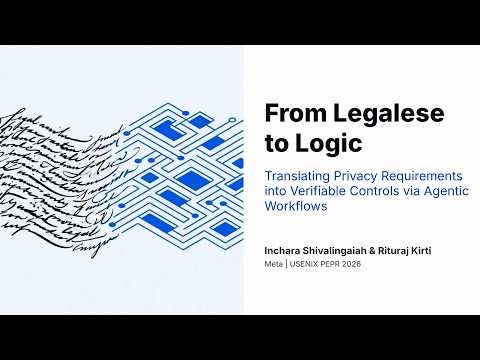
From Legalese to Logic: Translating Privacy Requirements into Verifiable Controls via...
summary
An LLM-powered pipeline that translates textual privacy requirements into implementable tasks uses a deterministic runner plus an agent network and Python guardrails to interpret intent, traverse lineage, and analyze candidate assets across billions of assets (often producing millions of candidate paths). It reduces multi-month manual effort to minutes, finds systemic patterns on first pass, self-corrects hallucinations, emits allow rules, and enforces simulation only changes with mandatory human signoff.
AI-written summary · about
chapters (13)
- 0:00Privacy requirement translation
- 1:55PrivacyWare for purpose limitation
- 3:42Manual to agentic workflows
- 4:25Agent workflow deep dive
- 6:31Banana data example
- 10:03Technical architecture and guardrails
- 12:07Autonomy versus oversight
- 13:09Risks in agent systems
- 14:57Manual workflow comparison
- 16:03Production insights
- 17:06Safe LLM deployment insights
- 17:27Takeaways and template
- 18:33Conclusion and future
related talks
 32mVirtual talk by Janardhan Kulkarni
 29mAutomating Privacy Reviews with LLMs: Challenges & Opportunities
 06mData Privacy Concerns and Solutions When using LLMs in Production
 16mAutomating Technical Privacy Reviews Using LLMs
 38mBehind the Firewall: Designing Secure LLM Pipelines for Regulated Data
 38mNobody Pages the LLM: Engineering Rigour for Vibe Coding
 47mA Step-by-Step Guide to Securing Large Language Models (LLMs)
 29mBeyond the Hype: Building Trustworthy and Reliable LLM Applications with Guardrails