Lessons From The Threat Modeling Trenches
summary
Built threat modeling programs across four organizations with hundreds of students, 100 formal trainings, and 1000s of threat models, the claim is that threat modeling becomes the keystone for secure development and culture change. Programs train and empower teams (not central parachute reviews), scale to ~110 security architects and ~4,000 developers, and use lightweight peer review governance plus Jira/version one for tracking. Concrete lessons: prioritize with context (use FAIR/Factor Analysis or JGERR), treat CVSS as a vulnerability score not a risk rating, iterate models, and expect to lose a single central repository unless captured deliberately.
AI-written summary · about
chapters (30)
- 0:00Introduction
- 1:07Threat Modeling
- 2:34My Experience
- 3:09I Built
- 3:35Threat Modeling Definition
- 5:06Why is Threat Modeling Important
- 6:24Design Misses
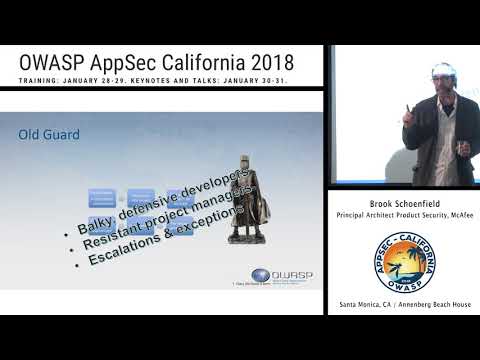
- 8:52The Old Guard
- 10:33Security becomes synonymous with no
- 11:00Can you be different
- 13:25Threat modeling becomes part of the woodwork
- 14:29Its a team sport
- 15:49Make it inclusive
- 16:43Let it breathe and grow
- 17:30Meltdown
- 18:50Bronze Age
- 19:27Iron Age
- 20:08Crystal Ball
- 23:58Prioritize
- 27:41Trust
- 28:54Architecture
- 33:07Governance
- 34:36Decentralization
- 37:20Design Problem
- 37:58Takeaways
- 38:40Selfpromotion
- 39:14Threat Modeling Library
- 40:18Resources
- 40:31CBS
- 40:56Impacts
related talks
 29mRedefining Threat Modeling: Security team goes on vacation
 58mThreat Modeling In And For Your Organization
 57mUnlocking Threat Modeling
 48mTeaching Software Engineers to Threat Model: We Did It, and So Can You
 01h 00mThreat Modeling for Secure Software Design
 39mValue driven threat modelling - security by design
 35mValue Driven Threat Modeling
 11mThreat modeling state of practice in Dutch organizations