Model-Agnostic and Efficient Exploration of Numerical State Space of Real-World...
summary
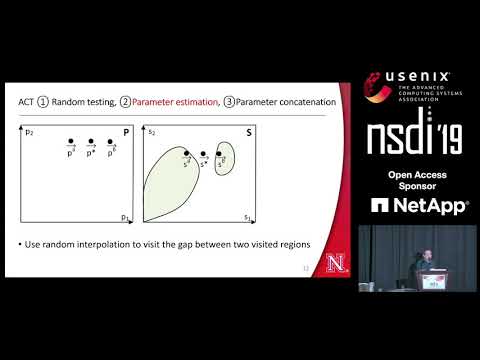
Presents ACT, a model-agnostic tester that combines random testing with guided feedback to explore TCP congestion-control numerical state spaces without abstract models. Implements random interpolation and parameter concatenation to jump gaps and corners in the mapping from network parameters (loss, bandwidth, delay, queuing, app rate) to states (cwnd, ssthresh, target, recovery flags). Evaluated on five Linux CCAs (CUBIC, BBR, Reno, H-TCP, Westwood) and tens of thousands of packets, yields higher state-region coverage and finds multiple real bugs that get fixed.
AI-written summary · about
chapters (21)
- 0:00Intro
- 0:51Multimedia Example
- 2:51TCP Example
- 3:57Automated State Space Exploration
- 4:36Automated congestion control testing
- 6:33Gap
- 7:11Corner
- 7:53Correlation
- 8:04Parameter Concatenation
- 9:25Experiments
- 10:36State Space Coverage
- 11:38Coverage Results
- 12:22TwoDimensional Projection
- 13:33Impact Detection
- 13:51First Test
- 14:12Bug
- 14:50Window
- 15:04Application Rate
- 15:42Window Decrease Behavior
- 15:56Bugs
- 17:00Conclusion
related talks
 17mTowards provably performant congestion control
 36mSimulating the Chaos of Real-World Networks for Resilient Applications
 37mExploratory Load-Testing with AI Tooling - it's Time to Ramp Up!
 14mModel-guided Fuzzing of Distributed Systems
 23mACK to the Future: TCP in 2025
 15mTesting Consensus Implementations using Communication Closure
 42mSimulation Testing
 45mTools for ART - Autonomous Real-time Testing