Blink: Fast Connectivity Recovery Entirely in the Data Plane
summary
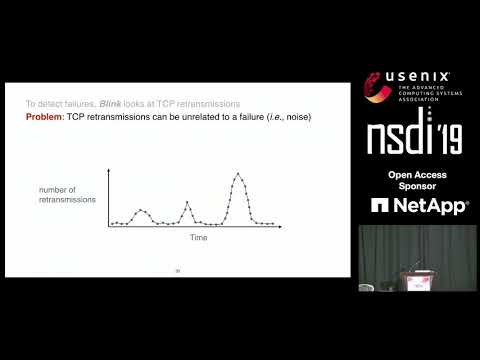
Blink detects remote outages from TCP retransmission waves by tracking 64 flows per prefix with an 800 ms window, counting flows with consecutive identical sequence numbers to avoid noisy retransmission spikes. It runs entirely in the data plane, is implemented in P4, uses prepopulated backup next-hops, and triggers reroutes often within one second (lab restore 1.17 s). Evaluation shows 65–94% true positive rates, near-zero false positives below 4% packet loss, and scalability to ~10K prefixes (~8 MB memory) on Tofino.
AI-written summary · about
chapters (5)
- 0:00Start
- 1:56Slow Internet Convergence
- 10:24How Can Blink Monitor Active Flows
- 12:34Accuracy
- 16:51Detect Loops and Black Holes
related talks
 18mTGW: Operating an Efficient and Resilient Cloud Gateway at Scale
 26mF10: A Fault-Tolerant Engineered Network
 12mDebugging Transient Faults in Data Centers using Synchronized Network-wide Packet
 12mStaying Alive: Connection Path Reselection at the Edge
 32mLive Q+A 2
 25mEnsuring Connectivity via Data Plane Mechanisms
 19mTackling DC Congestion and Bursts
 16mBackpressure Flow Control