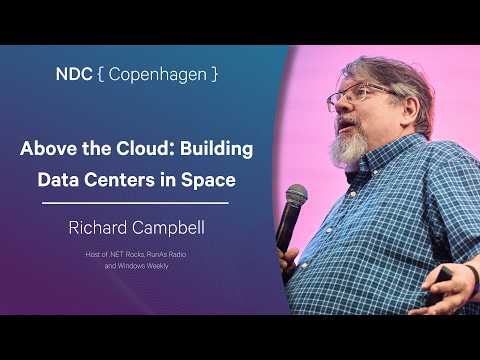
Above the Cloud: Building Data Centers in Space
summary
Calculations show a single NVL72 rack: 135 kW, 1.3 metric tons, 72 Blackwells needs roughly 450 m² of triple‑junction solar and ammonia radiators ~2×70 kW to dump heat, producing a 12–15 t satellite. Star Cloud proves a single H100 can run a nanoGPT for ~11 months; networking relies on Starlink optical mesh 100 Gbps with 5–10 ms intersatellite latency, so only inference (not model training) is feasible. Launch and collision risk (Kessler syndrome, ~50k tracked objects) and tens‑of‑millions‑per‑satellite costs make large-scale LEO AI fleets unlikely beyond thousands.
AI-written summary · about
chapters (18)
- 0:00Space data centers intro
- 4:21Why space data centers
- 11:24Choosing compute unit
- 12:47Building satellite
- 17:20Powering with solar
- 18:43Cooling in vacuum
- 20:06Satellite communication
- 22:30Battery challenges LEO
- 24:13Sun-synchronous orbit
- 25:58Launching heavy satellites
- 27:04How many satellites are too many satellites
- 31:40Collision risks debris
- 34:08Kessler syndrome
- 36:13Deorbiting satellites
- 39:22Space data centers practical
- 43:57SpaceX IPO hype
- 45:00Starlink internet capacity
- 46:28Q&A
related talks
 13mSpace Clouds
 56mInterplanetary compute: The Moon, Mars, and beyond
 08mRevolutionizing Data Engineering for Space Exploration
 16mA novel Cloud High Performance Computing infrastructure for user
 12mHow to cut through the noise and look at the physics behind cloud sustainability
 27mGreenOps Sustainable engineering 1
 43mSupporting NASA Science with OpenStack
 27mLive Panel: Building at the Roofline — Planning and Delivering Gigawatt-Scale AI Infrastructure