Ivy Zhu, Research Scientist, Intel @ MLconf SEA
summary
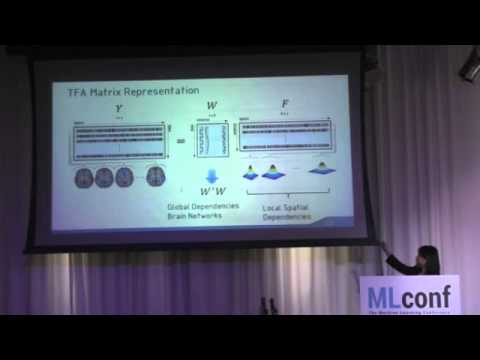
Presents a concrete algorithmic approach: a Bayesian hierarchical topographical factor analysis that models whole-brain images with latent factors instead of per-voxel weights, cutting the number of parameters by orders of magnitude and removing the false voxel-independence assumption. Demonstrates on rtfMRI data that these low-dimensional factors support near real-time fMRI decoding and reveal functional connectivity patterns, and reports work with Intel Labs and partners that adapts HTFA for low-latency, memory- and compute-constrained deployments.
AI-written summary · about
chapters (8)
- 0:00Start
- 1:33Functional Mri
- 7:09Task Specific Template
- 7:43Topographical Factor Analysis
- 8:44Objective of Tfa
- 14:48How Does It Compare with Other Factor Analysis Methods
- 15:56How Can We Bring Htf Org into Reality
- 19:49Speed Up Results
related talks
 26mTed Willke, Senior Principal Engineer, Intel Labs
 34mIrina Rish, Researcher, IBM Watson, NYC 2017
 50mExplainable AI Analysis & Visualization: Applications from Brain Computer Interfaces to ChatGPT
 32mIrina Rish, Research Staff, IBM T.J. Watson Research Center
 35mSteffen Rendle, Research Scientist, Google
 24mAI, Health & Confidentiality
 22mAnima Anandkumar, Electrical Engineering and CS Dept, UC Irvine
 01h 00mData, visualization, and designing AI