Ted Willke, Senior Principal Engineer, Intel Labs

summary
Claims real-time fMRI decoding can distinguish covert attention to faces versus scenes with around 95% accuracy by running MVPA and SVM on voxel time series. Pipeline performs spatial preprocessing, builds a full correlation matrix (about 500 million correlations per subject), then classifies and returns feedback to the scanner display. Optimization converts Pearson correlation into an MKL-friendly matrix multiply, vectorizes operations and uses Intel accelerators so the decoder runs near real time, and the live demo classifiers match subjects’ self-reports enabling closed-loop real-time neurofeedback.
AI-written summary · about
chapters (17)
- 0:00Intro
- 1:36Attention
- 3:02Brain
- 3:44Science Tool
- 4:35Data Set
- 6:01Machine Learning
- 7:22Attention Pipeline
- 13:44Neurofeedback Pipeline Example
- 15:18Neurofeedback Pipeline Challenges
- 16:49Scanning the Brain
- 18:32Full Correlation
- 19:28High Level Primitives
- 20:24Optimizations
- 22:36Model of the Mind
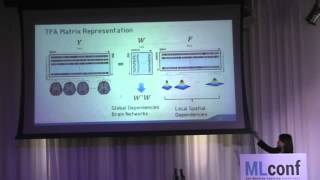
- 23:22Network Representation
- 24:05TFA
- 24:50Conclusion
related talks
 21mIvy Zhu, Research Scientist, Intel @ MLconf SEA
 31mJennifer Marsman, Principal Developer Evangelist, Microsoft
 11mConnected brains
 06mMachines and the magic of fast learning
 49mBuilding AI That Learns and Adapts: A Case Study in MRI Diagnostics
 09mNeuroAssist: Enhancing Cognition Computer Synergy with Adaptive AI & Enhance Neural Decoding
 36mMachine-Brain Intelligence in Brain-Computer Interfaces
 34mArtificial intelligence to accelerate MRI scans - Philips & LUMC winners in the...