Securing the IoT: High-speed cryptography and Edward Snowden
summary
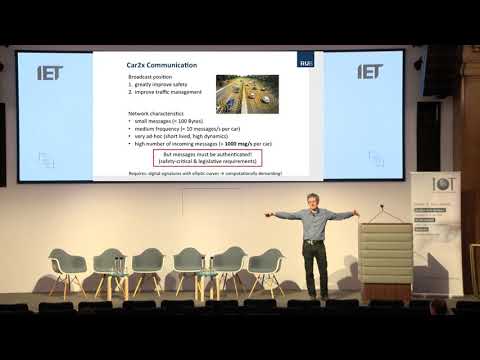
Work on car-to-car security yields a $10 prototype crypto engine that performs 1500 signatures/sec, meeting latency and cost targets for V2V authentication and supporting field trials; it targets elliptic-curve signing of ~100-byte heartbeat messages at 10 Hz. Research also demonstrates a dopant-level Trojan that collapses a TRNG from ~2^256 possibilities to a 2^32 keyspace, making offline key recovery trivial; the modification is hard to spot in layout but can be detected with targeted SEM-based inspection, motivating supply-chain and testing changes.
AI-written summary · about
chapters (14)
- 0:00Embedded IoT security intro
- 1:09IoT security importance
- 2:54IoT security threats
- 4:42Car-to-car case study
- 7:09High-speed crypto in vehicles
- 11:02Elliptic curve challenges
- 13:31Low-cost car security engine
- 14:13Hardware Trojans in IoT
- 18:23NSA hardware risks
- 19:04Hardware Trojan case study
- 22:14Exploiting random number generators
- 24:49Lessons from hardware attacks
- 25:31Research impact and future
- 26:36Conferences and learning
related talks
 35mIoT Cornerstones of Security
 31mSecuring the Internet of Things
 22mSecuring IoT for Life: Navigating the Challenge of Constant Change
 29mSecuring IoT/OT Against Modern Threats
 20mPost-Quantum Cryptography for the Internet of Things
 48mSecuring The Internet Of Things
 41mCryptographic speed, reliability & security
 38mIoT TLS: Why It's Hard