The Political Roots of AI Policy
summary
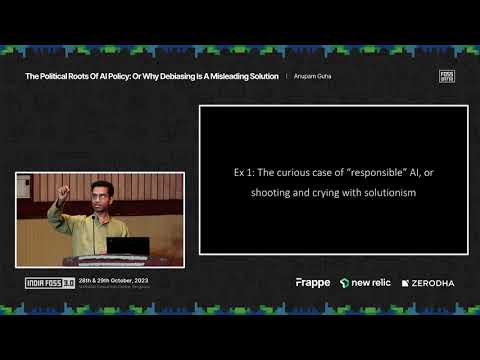
Machine learning is as much a social system as a technical one and governing it with AI safety as instrumentation — debiasing, explainability, benchmarks — fails. Examples: facial recognition in airports (DigiYatra), court summarization and discovery tools, emotion‑AI used in places like Gaza, and concentration‑camp scale deployments show debiasing and heat‑map explainers don’t stop harm. Benchmarks create fictional targets; stochastic models produce inevitable errors; society must decide which systems are allowed.
AI-written summary · about
chapters (12)
- 0:00AI and policy introduction
- 1:09AI as social and technical constructs
- 3:37Critique of AI safety efforts
- 6:50Bias discourse implications
- 9:18Epistemological roots of bias
- 12:10Digi Yatra case study
- 15:43Stochasticity limits in ML
- 17:33Reification dangers in AI
- 19:41Benchmarks and McNamara fallacy
- 21:49Myth of explainability
- 23:22AI as political problem
- 24:28Q&A
related talks
 23mThe AI Dilemma — Steering towards a More Humane Future
 01h 09mGOVERNANCE AND REGULATION OF AI FROM THE PERSPECTIVE OF AUTONOMY AND PRIVACY
 56mAn AI with an Agenda: How Our Cognitive Biases Leak Into Machine Learning
 40mAI: Legal and Policy Considerations and Landmines to Avoid
 29mResponsible AI Challenges and Recommendations
 05mToward Ethical AI
 34m(Un)Ethical Machines? Why AI Bias Is a Problem and What to Do About It
 25mPanel: Ethics and Regulations in AI Governance