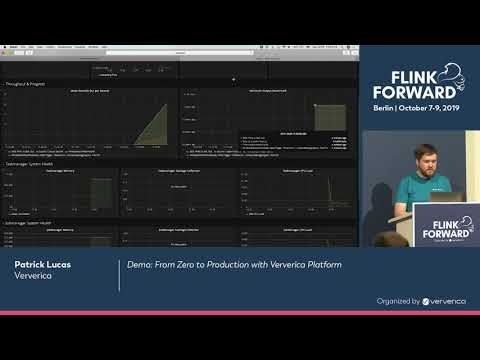
From Zero to Production with Ververica Platform
summary
A full demo shows a Kubernetes-native Ververica Platform install via Helm, creation of separate namespaces, and use of Minio S3 blob storage for jars, checkpoints and HA; OIDC login with Keycloak; and the platform auto-configuring automatic checkpoint configuration and metrics. The demo runs a Flink job, performs a Flink 1.8→1.9 upgrade by taking a savepoint, forks and reverts from that savepoint, triggers a fail-after-10s to show restart-from-checkpoint recovery, and exposes a Swagger JSON API for automation and RBAC—features function as demonstrated.
AI-written summary · about
chapters (10)
- 0:00Introduction to Ververica Platform
- 1:31Installing platform on Kubernetes
- 5:06Setting up namespaces and permissions
- 6:10Uploading and configuring jobs
- 7:15Creating and running deployments
- 8:43Automatic configuration and metrics
- 10:52Upgrading jobs with savepoints
- 12:45Handling job failures and restarts
- 13:29User access control and API demo
- 15:22Q&A and closing remarks
related talks
 43mApache Flink in Production with Ververica Platform
 24mKeynote: The Easiest Way to Get Operational With Apache Flink
 20mReliable, Real-Time AI with the Ververica Platform + a Kubernetes Operator in a Growing Startup
 26mKubernetes & real-time analytics: How to connect these worlds with Apache Flink
 19mTowards a Flink Autopilot in Ververica Platform
 38mA story about platform engineering — Niklas Voss
 07mDemo with Meaghan Kjelland - Software Engineer
 40mFrom concept to production; the fastest way to develop & deploy Apache Flink jobs