Output to Outcome: An Operating Model for the Age of AI

summary
Argues that AI-driven agents and developer tooling collapse the marginal cost of outputs toward zero, citing Planview data that only 8% of end-to-end delivery time is actual team coding across ~4,000 value streams, so 10x developer gains often hit other bottlenecks instead of more output. Describes building Planview agents for product/portfolio/value stream management, predicts 10x productivity via agents and parallel experiments, and prescribes seven organizational shifts — notably value streams as org units and modularity — plus a single unified cadence to turn extra capacity into measurable outcomes.
AI-written summary · about
chapters (15)
- 0:00Introduction
- 1:49AI-driven org models
- 2:30Tech revolutions history
- 3:55Constraints in AI age
- 4:38Outputs to outcomes
- 6:22Unready orgs' threat
- 7:04Outcome loop model
- 8:49Outcome tree & value streams
- 10:10Functions to flow
- 11:56Planning chaos to cadence
- 12:58Objectives to ownership
- 14:02Org modularity need
- 15:46Modularity & option value
- 17:55Outcome management model
- 18:59Feedback & upcoming book
related talks
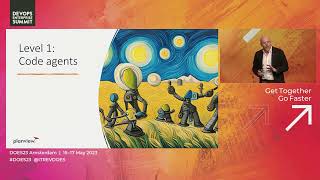 20mGenerative Value Streams: When Code is not a Constraint
 27mEngineering in the Age of AI: Making AI Work for Us, Not Replace Us
 43mFrom Pilots to Practice: Leading the agentic AI transformation
 37mFrom months into days: minimizing business development time to value with AI
 35mThe Future of Work: AI's Impact on Professional Success in 2025
 53mThe Human Side of AI: Unlocking Opportunity in the New Bottlenecks of Software Development
 38mFrom code to culture: How AI is reshaping the engineering organization
 18mLeveraging AI to Improve the Developer Experience