Choosing Linux for New Use Cases

summary
Examines Linux options for new industries like Cloud, IoT, drones and robotics by comparing different kernel/maintenance choices—including the LTSI (Long-Term Support Initiative). Covers sector-specific requirements such as varying software lifetimes (3–5 to 10–20 years), the value of open-source practices (upstreaming, code modification and knowledge sharing), and explains how LTSI’s governance and roadmap help industry developers.
AI-written summary · about
chapters (18)
- 0:00Intro
- 0:28Who am I Tsugikazu SHIBATA, NEC • Founder and project lead of Long Term Support Initiative (LTSI) that will help industry people to use Long Term Stable kernel with helpful activities. • Involved Linux kernel community since 2.4 and also a board member of Linux Foundation
- 1:22Linux is running everywhere Linux is running for multiple use cases - NYSE, London, Tokyo Stock Exchange - Amazon, Google, Facebook, Twitter - Android, TV, Camera, Router, Car navigation • Supports multiple architectures - x86, arm, s390, ia64, mips, parisc, sparc, sh ... • All those come from Single Source code tree
- 5:41Linux development policy • Upstream is only the place to accept the patches - Reviewed by skilled maintainer - Tested with other proposals to confirm no conflicts - Follow the development process
- 6:39Linux Development process • Just after the release of 4., two weeks of merge window will be opened for proposal of new features • After 2 weeks of merge window, -rch will be released and the stabilization will be started • 4.n+1 will be released when it becomes reasonably stable by some of-reX released
- 7:48Kernel release cycle • Release cycle of Linux kernel is about 65days
- 10:11Status of Latest Linux kernel Again • Latest released Kernel: 4.8 • Current Stable Kernel: 4.8.1 . Current development kernel in the merge window for 4.9-rci
- 11:38LTS: Long Term Stable Kernel • Kernel tree continue to back port bug and Security fixes • Extended maintenance period for stable kernel • Pick one version per year and maintain 2 years
- 12:20Why LTS? . Only the tree to get fixes from the community • In the real use case, tested/confirmed kernel is important, less important for new features • Fixes will be released # of times and should be applied frequently, Security/Bug fixes are being more important • Bugs found in LTS should be reported and fixed in upstream
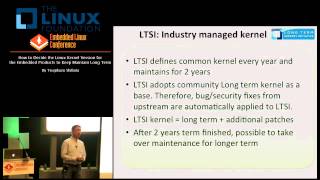
- 17:28Open Source community to create and maintain Linux kernel for long term -Based on LTS - Add another chance to include further patches on
- 18:15LTSI Add vendor required features Share status, info, problem among industry people Huge testing by contributors Auto test framework Provide help to developer for upstream LTS Release 1 version/year, Maintain 2 years Frequently and large number of bug /security fies
- 19:05History of LTSI • Established 2011 - 5 yeas now -Started for stable Kernel for Android • Integrated by Yocto (2012, May) • Have had a workshop/session to share information and discuss issue among industry people • Released yearly basis; 3.0, 3.4, 3.10, 3.14, 4.1
- 20:42Shape of LTSI Project • Small staff to coordinate workshop, session at LF conference • Maintainer: Greg Kroah-Hartman, Fellow of Linux Foundation • Working with upstream Linux Community • Keeping neutral position to be able to use for variety of use case
- 23:35LTSI as a part of Distro • Yocto project has a normal option to use LTSI - You can create your own distribution with LTSI - Yocto is doing their own tests for the distribution with LTSI. Both build distro and run it. Many of report/blog in the internet using Yocto and LTSI
- 24:24Fuego: Auto test package • Jenkins based auto test packages (using Docker) - Distributed under 3-clause BSD license - Over 50 test packages included with Web based
- 25:36Use Case: Automotive Grade Linux • Developing reference implementation called UCB (Unified Code Base) distribution v1.0 using LTSI 3.14 kernel - AGL/UCB is using Yocto and LTSI • Have had a demonstration at CES 2016 Las Vegas with announcement • V2.0 Brilliant Blowfish was released July 12 • V3.0 is planned to be released Jan. 2017
- 27:04Use Case: Civil Infrastructure Platform • Established Feb 2016, by Toshiba, Hitachi, Siemens and others to create reference distribution for Civil infrastructure • One of major requirement includes Super Long Term Support: 10-15 years • Planning to take over maintenance of LTSI
- 30:57LTSI Schedule expectation • Kernel Summit 2016 will be the time to decide LTS version
related talks
 43mUsing Linux as Long Term Working with the Community
 39mUsing Long Term Stable Kernel for the Embedded Products
 39mTowards Sustainable Systems with the Civil Infrastructure Platform
 32mState of Linux
 33mUsing Open Source Software to Build an Industrial-grade Embedded Linux Platform...
 39mCivil Infrastructure Platform: State of Industrial Grade Linux
 34mHow to Decide the Linux Kernel Version
 02mthe Future of Linux