Beyond Deep Learning: Next Generation AI

summary
Claims a Guided Transfer Learning method that cuts training data needs by 3–5 orders of magnitude, based on a neuro-inspired architecture that inserts gates that persist for minutes to rewire networks between inputs. Provides papers, code and equations available, reports six to seven years of development and working prototypes that improve few-shot generalization but fall short of full AGI or household robots. Uses standard tools (PyTorch, GPUs) though implementations need parallelization work; success criterion is flexible, situational robot behaviour rather than a Turing test.
AI-written summary · about
chapters (15)
- 0:00Next-gen AI intro
- 1:31Speaker background
- 4:17Deep learning limits
- 9:32Neural network gates
- 15:50Gates vs traditional nets
- 21:21Gate-based AI progress
- 24:21Hardware challenges
- 27:39Q&A: Single-example learning
- 29:06Q&A: Gates vs attention
- 33:00Q&A: Pruning vs gates
- 35:07Q&A: Biological plausibility
- 39:49Q&A: Success criteria
- 43:00Q&A: Situational memory
- 47:58Q&A: Quantum gates
- 50:46Closing remarks
related talks
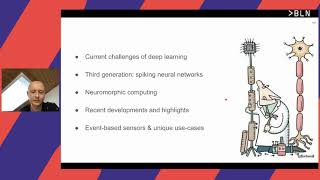 29mDeep Learning, Neuroscience and the future of AI
 12mAugmenting Human Capabilities to New Dimensions
 41mDeep Learning to Solve Challenging Problems
 13mAI: Big Expectations
 24mKeynote: Next-generation frameworks for Large-scale AI
 22mGenerative AI & its Transformation of Business, Research, and Society
 31mMyth & Truth behind Artificial General Intelligence
 26mGenerative AI: Get a Grip … and a Look Under the Hood