A page out of Server driven UI on Android

summary
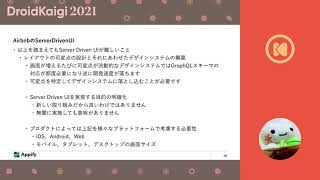
Server-driven UI uses JSON configs to change screens, run A/B tests and flip feature flags without shipping an APK update. Implementation uses Epoxy (RecyclerView-based) for a JSON→EpoxyModel pipeline and Jetpack Compose hoisted composables for declarative mappings. The prototype wires Moshi polymorphic adapters and discriminator keys to pick component types, builds a reusable design-system library, and shows Epoxy running in production for ~2.5 years while the Compose version renders dynamic homepages and per-user experiments successfully.
AI-written summary · about
chapters (8)
- 0:00Introduction and overview
- 2:11What is server-driven UI
- 10:13Core principles and goals
- 15:31Epoxy library deep dive
- 22:57Code implementation with Epoxy
- 33:45Jetpack Compose approach
- 38:54Dynamic screen configuration
- 40:17Resources and Q&A
related talks
 48mA page out of Server driven UI on Android
 33mA page out of Server driven UI on Android
 49mLife is too short to develop only for Android - A journey to Server-driven UI
 29mUsing server-driven UI to rapidly iterate across platforms
 24mServer-Driven UI with Jetpack Compose and GraphQL
 24mUsing Server Driven UI to rapidly iterate on Android and Across Platforms
 42mUsing Jetpack Compose to Create Apps From Figma UI Sketches
 49mBuilding an Android UI using declarative programming in Jetpack Compose