The power of Camera APIs and OpenGL all together

summary
Shows how to grab raw frames from CameraX + Camera2 and hand them to OpenGL ES (vertex + fragment shaders) to build real effects: implemented a fragment shader grayscale and color inversion, overlays glued to face landmark coordinates (glasses, hats) and exported the manipulated frames from a byte buffer into a recorded video. Uses GLSurfaceView for preview and OpenGL ES 3.x where available. Performance note: phones cannot process 60 fps per-frame—practical solutions skip frames and process roughly 2–3 frames per second to avoid lag.
AI-written summary · about
chapters (10)
- 0:00Introduction to Camera APIs
- 5:01Camera APIs overview
- 8:49Rasterization and GPU role
- 10:15OpenGL fundamentals
- 15:23Manipulating camera frames
- 20:59Adding custom objects
- 24:29Recording manipulated frames
- 26:16Real-life use cases
- 28:43Hardware limitations
- 30:29Takeaways and summary
related talks
 41mCreating delightful camera experiences
 27mGetting Started with CameraX
 36mBuilding an AR app with Compose & OpenGL ES
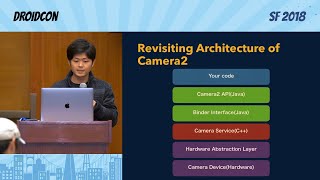 42mCamera2 API and beyond
 45mNative CameraX in Jetpack Compose - Filling the View-Shaped Hole
 31mBuilding Camera Features in a Snap
 01h 21mCameraX Workshop
 39mBuilding Camera and Media Apps That Run Anywhere