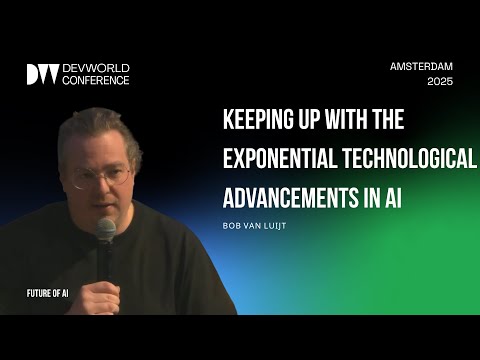
Keeping up with the exponential technological advancements in AI
summary
Claims that vector embeddings resurface around 2015 and that compressing co‑occurrence matrices into embeddings enables semantic search lead to a concrete product: Weaviate starts as a vector database around 2019–2020 to store and query those embeddings, integrates OpenAI embeddings (five lines of code demo), optimizes retrieval in assembly, and ships three agents in March — query agent, transformation agent, and personalization agent — for semantic queries, data transforms and reranking; local CPU inference and million‑token context windows (Flash 2.0) are flagged as practical trends.
AI-written summary · about
chapters (14)
- 0:00Vector embeddings and WV8
- 3:09IoT data to embeddings at WV8
- 5:57ChatGPT’s impact on WV8
- 8:02Running AI locally with embeddings
- 10:48Rapid AI advancements
- 13:15AI agents and purpose
- 16:28Context windows vs vector databases
- 18:59Why WV8 chose Go for its database
- 21:25Client to library interfaces
- 22:49AI data limits and synthetic training
- 24:34Multimodal embeddings and future models
- 26:45Embeddings beyond text and DNA
- 28:13WV8’s database agents feature
- 30:21Closing remarks and Q&A
related talks
 08mRethinking your data stack: The future of AI apps and vector databases
 13mThe State of AI Powered Search and Retrieval
 48mEnter the Brave New World of GenAI with Vector Search
 33mEnter the Brave New World of GenAI with Vector Search
 31mBring AI based Search to Your Website
 47mBoosting AI With OpenSearch: Vector Stores, Similarity Search, and Retrieval-Augme...
 33mVector Databases for GenAI applications
 22mGenerative AI application stack and providing long term memory to LLMs