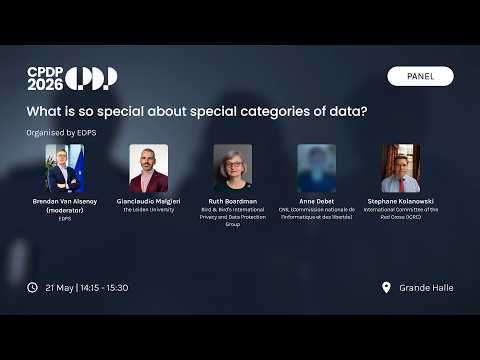
What is so special about special categories of data?
summary
Court of Justice case law treats indirect inferences as falling under Article 9 and multiple judgments (at least four) expand the boundary of special categories of data; regulators and drafts like the Digital and AI Omnibus allow narrow exceptions for AI bias testing and provider-side training but leave gaps for model scraping and generative outputs. Practical tools cited include palm‑vein and fingerprint biometrics, voice templates, foundation models, and model unlearning; humanitarian practice limits biometrics to travel documents and tracing, while France’s strict rules and a national DNA database of ~2.5M show tighter protection yet enforcement and cross‑border sharing remain problematic.
AI-written summary · about
chapters (6)
- 0:00Special categories of data
- 14:51Court interpretation of special categories
- 35:56Private sector challenges under Article 9
- 1:01:41Regulator perspectives on sensitive data
- 1:13:59Biometrics in humanitarian crises
- 1:20:00Q&A on data protection
related talks
 05mPrivacy, identity, and autonomy in the age of big data and AI
 01h 16mData protection and Big Data: what about regulating Big Data analytics?
 01h 09mGOVERNANCE AND REGULATION OF AI FROM THE PERSPECTIVE OF AUTONOMY AND PRIVACY
 01h 11mBack to Basics How Data Protection Principles Apply to AI Systems
 01h 17mBias, Discrimination and Data Protection in the Age of GPAI
 01h 00mNavigating the Biometric Anatomy
 30mAI Regulation - How to implement AI legally compliant?
 40mGDPR in Practice – What's Hot, What's Not