C++, C#, Rust or Python - Which is the Best Choice for Low Energy Consumption?
summary
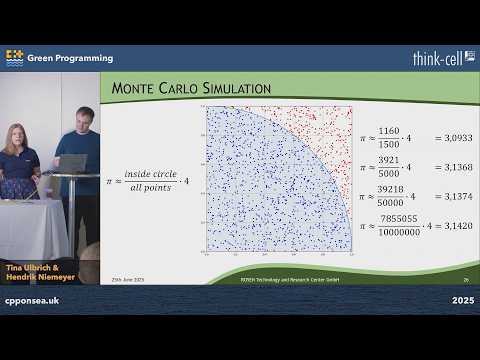
Reproduces benchmarks for Monte Carlo pi with 10 million samples and an Adler‑32 checksum on 50 MB, measures energy via Code Carbon (RAPL/Intel PCM fallback) on WSL, and publishes code on GitHub. Results show compiled languages like C/C++/Rust use the least energy while Python uses the most, energy correlates with runtime not memory, per‑run variability is ~±0.5 normalized units, and moving from Germany to Norway cuts CO2 by about a factor of 10.
AI-written summary · about
chapters (12)
- 0:00Green programming challenges
- 5:20Green software principles
- 9:11Language energy efficiency research
- 11:59Energy measurement experiments
- 17:33Energy and CO2 tracking setup
- 27:24Monte Carlo pi results
- 30:35Adler-32 results
- 31:40Optimization strategies
- 35:13Energy measurement tools
- 37:18Hardware impacts
- 41:57Greener software steps
- 47:00Conclusion
related talks
 01h 30mTuning C++: Benchmarks, and CPUs, and Compilers! Oh My!
 45mFil-C: memory safety with fanatical C/C++ compatibility
 01h 21mAccelerating Python With C++
 49mAn Engineering Approach to Optimising C++
 41mUnderstanding 5 languages memory models (or most of them)
 45mThe existential threat against C++ and where to go from here
 45mPerformance Benchmarking with Celero
 01h 08mC++ MythBusters Strike 2