Extremal Mechanisms for Differential Privacy
summary
Proposes a concrete staircase mechanism (noise adding, parameterized by a single gamma) that minimizes worst case cost for integer and real queries and whose likelihood ratios take only three-valued likelihood levels (e^ε, 1, e^−ε). Proves this family dominates other data‑independent mechanisms via hypothesis testing and Blackwell comparisons, gives closed form costs (variance and mean) with exponential gains in low privacy and a knee near ε≈2–5, and derives exact composition formulas (no extra log(1/δ) loss). Works under worst‑case, data‑independent assumptions; interactive and query‑dependent generalizations remain limited.
AI-written summary · about
chapters (19)
- 0:00Intro
- 0:58Information Theory and Differential Privacy
- 3:11Binary Inference Errors
- 4:54Information Theory is Mature
- 6:06This Talk
- 7:39State of the Art
- 11:34Example Cost Functions
- 14:12Universal Optimality
- 16:00Price of Privacy
- 19:13Properties of 7
- 22:35Canonical Result
- 24:18FA-MD Tradeoff Curves
- 26:01Binary Query
- 27:00Operational Look
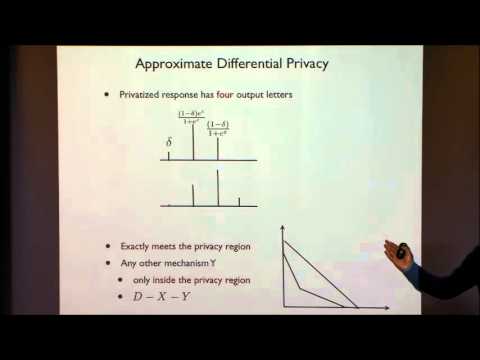
- 28:48Approximate Differential Privacy
- 33:52Composition Theorem Simplified
- 34:59Applications of the Composition Theorem
- 36:29Back to the Staircase Mechanism
- 42:58Summary
related talks
 01h 00mDifferential Privacy: Fundamentals to Forefront I
 01h 03mStatistical Inference and Privacy, Part II
 30mAccuracy First: Selecting a Differential Privacy Level for Accuracy-Constrained...
 47mDifferential Privacy from a Statistical Perspective–Obtaining Valid Inferences...
 42mDifferential Privacy
 01h 07mStatistical Inference and Privacy, Part I
 34mOptimal Privacy-Constrained Mechanisms
 26mAlgorithms with More Granular Differential Privacy Guarantees