Log-concave Polynomials and Spectral Independence 2
summary
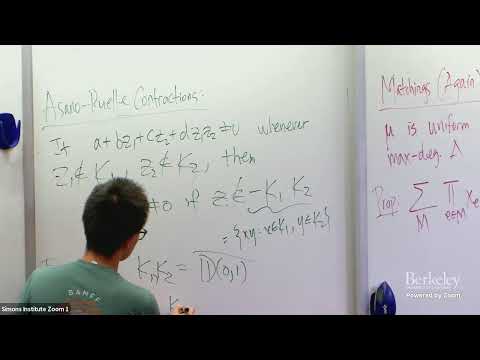
Shows that log-concavity of g_mu and explicit zero-free region around 1 each imply spectral independence by translating marginals and pairwise influences into first and second derivatives of log g_mu, so operator norm of the influence matrix is bounded (proof gives O(delta^2) in the stated setting). Uses complex analysis (Schwarz–Pick style bound) by building maps phi and C so a univariate holomorphic f recovers influences, and uses Asano–Ruelle contractions to prove multivariate zero-freeness for matchings and spanning trees by reducing to quadratic checks via successive contractions.
AI-written summary · about
chapters (15)
- 0:00Introduction
- 1:39Polynomials and spectral independence
- 7:19Key properties for spectral independence
- 11:20Log concavity meaning
- 17:26Proving log concavity via trickle down
- 21:15Spanning trees example
- 24:40Zero freeness approach
- 26:57Zero free regions and spectral independence
- 30:33Complex analysis for zero freeness
- 36:35Constructing univariate function
- 46:16Zero freeness proof by contradiction
- 46:37Matchings application
- 51:15Deforming polynomials
- 54:07Asano-Ruelle contractions
- 59:27Summary
related talks
 49mDiscrete Optimization using Log-Concave Polynomials
 27mSharp Matrix Concentration
 49mInfluences in Gaussian Space
 57mCompletely Log-Concave Polynomials
 01h 03mHigh Dimensional Geometry and Concentration II
 01h 11m(Hidden) Symmetries of Computational Problems (continued)
 57mHigh Dimensional Geometry and Concentration I
 54mNegative Dependence and Lorentzian Polynomials