Log-concave Polynomials and Spectral Independence 1
summary
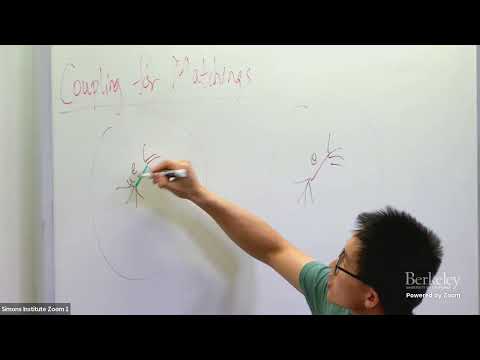
Defines spectral independence as the largest eigenvalue of a conditional influence matrix and proves bounded η for all conditionals yields a spectral gap ≳ n^{-O(η)}, hence polynomial mixing of Glauber dynamics; with a graph factorization + bounded degree + nonvanishing marginals one gets a log-Sobolev type bound and n log n mixing. Tools include Dirichlet forms, couplings (sum of influences ≤ expected Hamming distance), and geometry of polynomials; examples: spanning trees give constant bounds, matchings give O(Δ) bounds.
AI-written summary · about
chapters (9)
- 0:00Introduction to the topic
- 4:33Glauber dynamics and mixing
- 8:01Functional inequalities
- 16:37Defining spectral independence
- 24:06Analyzing independence
- 30:13Theorems on spectral dependence
- 37:30Verification techniques
- 44:05High-dimensional expansion
- 53:09Coupling for matching
related talks
 57mIt ain't over till it's over
 49mGeneralized Cheeger Inequalities and Constrained Clustering
 27mSharp Matrix Concentration
 56mSome Probabilistic Uses of Dirichlet Eigenvectors
 36mThe Overlap Gap Property For Inference: Power And Limitations
 01h 03mHigh Dimensional Geometry and Concentration II
 45mRandom Walks on Directed Graphs
 11mUnderstanding Statistical-to-Computational Gaps via Low-Degree Polynomials