How to Evolve Your Way Out of a Paper Bag
summary
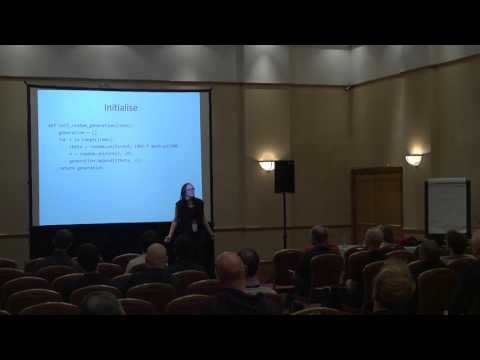
Shows a working Python genetic algorithm that evolves angle and velocity pairs to launch particles out of a 10x5 bag, starting from a random population, using mutation 10% and simple crossover; initial all‑or‑nothing fitness fails, switching to a numeric height metric plus interpolation fixes stability and speeds it up (runs sometimes reach 31/32 alive). Also implements Conway’s Game of Life in C++/SFML, experiments with wrapping edges, and tries evolving rules and starting states; code and examples are on GitHub.
AI-written summary · about
chapters (19)
- 0:00Start
- 0:34What Evolution Means
- 4:13The Fitness Function
- 6:10The Soft Ai
- 14:22Building Up the New Generation
- 17:04How Do I Select the Best Things
- 17:22Three Main Approaches
- 17:50Proportional Selection
- 37:08Frameworks for Genetic Algorithms
- 51:22Demo
- 57:11Mutation Testing
- 57:41Property Based Testing
- 58:57How Do I Know How Good those Tests Are
- 1:01:19Python Mutation Testing
- 1:03:45Genetic Algorithms and Cellular Automata
- 1:08:09How Do I Do Cross Over with My Rooms
- 1:11:37Mutation
- 1:12:58Mutation Rate
- 1:15:56Genetic Algorithms
related talks
 48mTight Genes: Intro to Genetic Algorithms
 46mTight Genes: Intro to Genetic Algorithms
 57mSolutions That Evolve: Building Self-Improving Systems with Genetic Algorithms
 45mKeynote: Writing Code? Pfft... Evolve it Instead!
 01h 06mTurtles! Hill climbing! Hammers! Paper bags!
 56mAn Introduction to Reinforcement Learning - Snake Your Way Out of a Paper Bag
 53mAn Introduction to Reinforcement Learning - Snake Your Way out of a Paper Bag
 46mTight Genes: Intro to Genetic Algorithms