Crimson: A New Ceph OSD for the Age of Persistent Memory and Fast NVMe Storage
summary
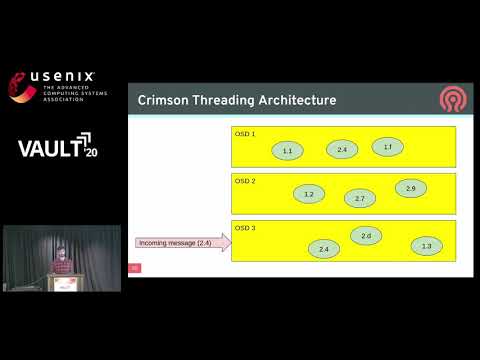
Crimson is a reimplementation of ceph-osd built on seastar that replaces blocking thread pools with one reactor per core and async futures to cut cross-core locking and context switches. Current prototype already supports peering and basic I/O replication works and runs benchmarks that show almost no CPU while matching throughput and latency versus classic OSDs, but it cannot yet persist to disk; work focuses on porting BlueStore and a new Cstore backend to exploit ZNS and persistent memory.
AI-written summary · about
chapters (20)
- 0:00Intro
- 0:11Storage Keeps Getting Faster
- 0:27CPUs, not so much
- 1:30Ceph Architecture
- 1:54RADOS
- 3:00OSD Threading Architecture
- 5:07Classic OSD Threads
- 6:42Crimson!
- 8:30Programming Model
- 10:24Crimson Threading Architecture
- 12:41Current Status
- 13:46Performance
- 14:33BlueStore - Alien
- 15:15BlueStore - Seastar Native
- 19:26ObiectStore
- 21:22Seastore - Logical Structure
- 22:16Seastore - Why use an LBA indirection?
- 22:38Seastore - Layout
- 24:04Seastore - Persistent Memory
- 24:30Questions?
related talks
 45mSecuring Confidential VMs with COCONUT-SVSM
 35mBreaking language barriers:High-performance IPC with iceoryx2
 29m"10 Years of Redox OS and Rust"
 06mRedox OS Update
 43mBuilding a VMM in Rust for the Edge
 24mCloud-hypervisor: A new choice for virtual machine monitor
 01h 04mConcurrency TS2: Improved C++ Concurrency and Lock-free Programming
 27mWhoops! I Rewrote It in Rust