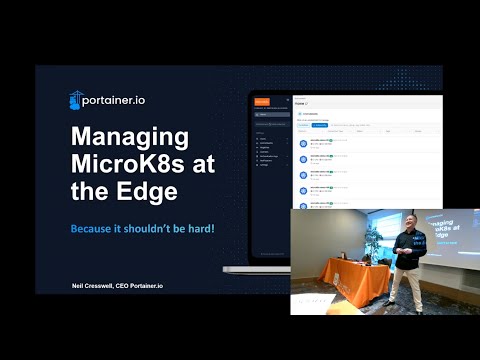
Managing MicroK8s at the Edge
summary
Portainer automates MicroK8s cluster creation by SSHing to Linux hosts, running snap install microk8s, configuring 1‑ or 3‑node edge clusters, locking them down and adding add‑ons, then importing them into a central UI. Centralized features include an API proxy that serves a single kubeconfig, RBAC role/namespace provisioning, a reverse‑tunnel agent for 4G devices, concurrent manifest pushes to groups, Open Policy Agent support, and an open‑source core with tested against 1,500 clusters (scaling tests toward 50,000 nodes).
AI-written summary · about
chapters (9)
- 0:00MicroK8s and Portainer intro
- 3:17Why MicroK8s best on-prem
- 7:07Managing multiple MicroK8s clusters
- 9:33Centralized Kubernetes auth
- 13:04API proxy for secure access
- 15:35Consistent deployments across thousands of clusters
- 20:07Governance with Open Policy Agent
- 21:33Navigating CNCF landscape
- 23:38Q&A
related talks
 32mK3s and MicroK8s: Lightweight Kubernetes for Edge and IoT Applications
 34mManaging Edge Nodes With “KubeEdge”
 41mRunning Kubernetes on Workstations and Edge / IoT Devices
 20mKubernetes at the Edge
 24mDemo of Kubernetes at the Edge for AI Model Deployments
 36mKubernetes On the Edge With K3s For a Smart Metering Use Case
 10mKubernetes: Enabling Edge Workloads
 10mDevelop once, deploy anywhere: flexible infrastructure extends to the edge