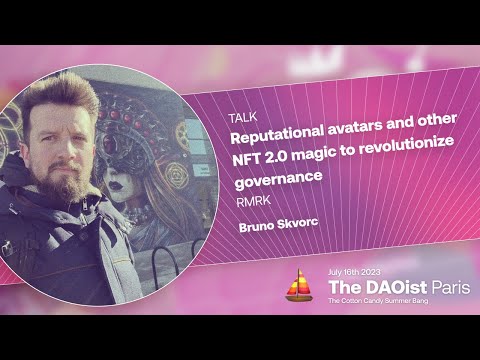
Reputational avatars and other NFT 2.0 magic to revolutionize governance
summary
A deployed NFT 2.0 stack lets avatars carry modular assets, lock reputation and act as accounts using finalised standards: ERC-5773 multi‑output, ERC‑6454 soulbound. Implementations are live on Moonbeam and just launched on Ethereum with Polygon next, accessible via evm.rmrk.app and the playable marketplace singular.app. Nestable and equippable NFTs let badges and game skins be compatible across collections, reputation is numeric or categorical and can be locked inside avatars, and recovery primitives like semi‑bound transfers and two‑party acceptance are already implemented.
AI-written summary · about
chapters (12)
- 0:00Introduction
- 1:04DAO governance challenges
- 2:28Limitations of NFTs 1.0 and evolution to NFTs 2.0
- 3:11ERC-5773 multi-asset NFTs
- 4:55Nestable and equippable NFTs
- 6:59Soul-bound tokens and reputation
- 8:44Reputation equippables interoperability
- 10:06Gamified reputation mechanics
- 12:51Reputation vs token voting
- 13:54Real-world use cases
- 15:20Getting started with NFT 2.0
- 16:33Q&A
related talks
 17mThe future of our digital identity: NFTs or Verifiable Credentials?
 20mLiving Assets: Evolutive NFTs for Playing Fair in the Metaverse
 18mLiving Assets: Evolutive NFTs for Playing Fair in the Metaverse
 30mSocial Composability Design: How DAOs Can Leverage It for the Future of Work
 19mSocial Contracts for Web3 Coordination
 11mModular User Experience
 31mThe Promise of Metaverse and Digital Property: A New Era of Innovation
 13mMulti-chain governance: How can DAOs live across chains