Practical Fractals in Space

summary
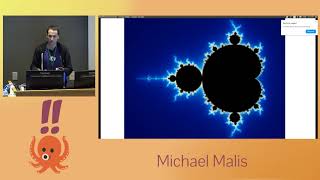
Argues that space‑filling curves truly map multi‑dimensional keys into a single order that preserves locality and gives concrete implementations: bit interleaving for Morton (Z-Order), gray‑code + rotations for Hilbert, worked examples and code in Julia+Gadfly. Compares tradeoffs (Morton is simple but makes large jumps, Hilbert gives better locality at higher implementation complexity), shows a 3D print, cites SLURM’s hilbert.c and use cases: navigation, image search, collision detection.
AI-written summary · about
chapters (5)
- 0:00Start
- 2:49Logistic Map in C++
- 25:32properties of fractals
- 32:36Collision Detection
- 34:432D is easier for our brains to handle.
related talks
 25mMulti Dimensional Clustering with Z Ordering
 12mGenerating fractals … with SQL queries!!!
 48mA Helicopter Tour of Purely Functional Data Structures
 43mResizable Sketches
 41mExotic Functional Data Structures: Hitchhiker Trees
 01mScale By the Bay 2021 intro video by Russell Spitzer
 13mInterpolation Search Can Be Fast, in Some Situations, Sometimes, If You Try!
 52mData Over Code: A Short Hyperbole