What Referential Transparency can do for you

summary
Argues that referential transparency buys concrete benefits: easier testing, memoization, automatic parallelization and compiler optimizations; demonstrates a hand‑rolled IO monad (shows deferred side effects but warns about stack‑safety and missing resource guarantees), then points to real solutions—cats effect, Monix Task, FS2—that add cancellation, finalizers and streams; shows Futures break referential transparency and recommends wrapping them; outcomes are working toy examples plus measured tradeoffs and clear migration paths to production libraries.
AI-written summary · about
chapters (8)
- 0:00Introduction
- 1:00What is referential transparency
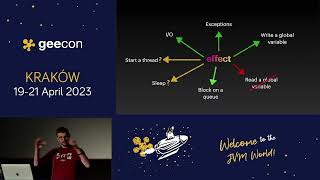
- 1:43Side effects
- 6:30Testability
- 9:00Optimizations
- 14:41The Nother Problem
- 21:17Monads
- 25:41Conclusion
related talks
 30mCONQUERING CONCURRENCY WITH FUNCTIONAL PROGRAMMING
 51mEffects: to be or not to be?
 41mFunctional Programming for Dummies*
 01h 06mThe Joy of Functional Programming
 01h 04mHaskell - A Peek Inside the Ivory Tower
 44mCAN WE FREE CONCURRENT PROGRAMMING FROM THE MONADIC STYLE
 33mExtensible Effects: A Leaner Cake for Purely Functional Code
 36mHow Functional Programming Can Make Life Easier