Next generation Scala builds with CBT

summary
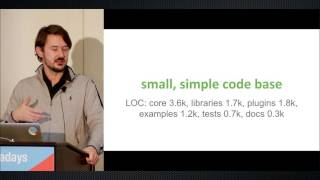
CBT claims a practical replacement for slow Scala build tools: a resident background JVM that gives lightning fast response time, build definitions written as plain Scala build files (no DSL), and an integration path into IntelliJ IDEA and Ensime. The project compiles itself on edits, wires tasks as Scala methods, caches task outputs, and supports Maven/git/directory dependencies, multi‑project and cross builds, templates and plugins — a compact codebase (~7k LOC) that the demo shows working interactively. self-compiling resident process
AI-written summary · about
chapters (23)
- 0:00Intro
- 1:24What is CBT
- 2:27Why build
- 3:28Why CBT
- 6:43CBT in IntelliJ IDEA
- 15:01About CBT
- 16:43The state of CBT
- 24:40Plugins
- 27:07Task scoping
- 31:45Dependencies
- 32:56Fake SBT builds
- 33:42Command line overrides
- 36:15Join us
- 41:02Server mode
- 42:30Exception
- 43:49CBT version
- 44:38CBT plugins
- 46:22CBT vs Gradle
- 48:08Leaking resources
- 51:33How does CBT interact with Java modules
- 52:34How would you handle multiple modules
- 53:43Adding dependencies
- 54:33More questions
related talks
 41mCBT A New, Intuitive Build Tool for Scala
 58mElegant Scala builds and bootstrapping Dotty with CBT
 32mBetter Scala builds with the Mill build tool
 34mComplex Problems, Simple (build)tool
 03mInterview
 19mExploring Scala Tooling ecosystem
 31mExploring Build Caching - A Practical Overview
 49mA live-coding introduction to Mill: finally a build tool we can all understand!