How We Built Tools That Scale to Millions of Lines of Code

summary
Twitter faces tens of millions of Scala lines organized into tens of thousands of targets and builds a lightweight semantic pipeline instead of reusing the full compiler: a SemanticDB protobuf schema plus a scalac plugin emits per-file semantic payloads, those payloads feed a queryable SQLite index (≈500 MB per million lines) with single- or double-digit ms lookups, exposed via a company-wide language server and used by Metals/Scalafix/meta-doc and distributed rewrite jobs — experimental results show it scales and works.
AI-written summary · about
chapters (26)
- 0:00Introduction
- 2:26The Problem
- 7:10The Solution
- 11:52Overview
- 15:22Taystee
- 16:20Scala Meta
- 17:18Semantic DB
- 18:12Text Document
- 19:02Semantic DB Example
- 20:19Metabeam
- 20:48Symbols
- 21:18Currencies
- 22:05Scala Sphere in Crime
- 22:55Examples
- 23:17MetaDoc
- 23:41MethodDoc
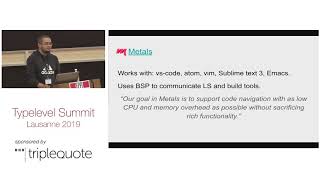
- 25:44Metals
- 26:37Metal
- 27:33Code Actions
- 28:40ScalaFix
- 30:25Companywide Semantic Index
- 33:02Experimental IntelliJ Plugin
- 34:07Fabricator
- 34:57Evolution
- 36:17Summary
- 37:13Questions
related talks
 57mBuilding code analysis tools at Twitter
 19mExploring Scala Tooling ecosystem
 50mMove fast and fix things
 29mExploring Scala Tooling ecosystem
 32mBetter Scala builds with the Mill build tool
 49mBuilding Safe, More Testable Scala Production Systems
 01h 29mScalafix Workshop
 39mUnleashing Scalafix potential with custom rules