More Needles in the Hay Might Make it Harder to Find One?
Talkat Satisfiability Lower Bounds and Tight Results for Parameterized and Exponential-Time Algorithms · on Friday, 2015-11-06
summary
Shows that few solutions can speed some NP-hard cases: directed Hamiltonian cycle maps cycles to parity of xyz vertex partitions and lists y-parts in expected phi^n time then finishes by Gaussian elimination over GF(2) to get a 1.618^n algorithm; combining a randomized edge-sparsification yields n choose k · 1.618^n when there are ≤2^k cycles. For k-coloring of bounded-degree graphs, counting modular in/out subgraphs gives a (d/2+1)^pw time algorithm when k>d/2, bypassing the k^pw SETH barrier.
AI-written summary · about
chapters (21)
- 0:00Intro
- 1:03Unique solutions cannot help too much
- 1:40Uniqueness doesn't help at all for Satisfiability
- 2:12Two candidates where uniqueness might help
- 2:40Arithmetical algorithms
- 3:18Directed hamiltonian cycle
- 3:32Example with 2 hamiltonian cycles
- 3:47Count vertex partitions
- 6:06All partitions IV
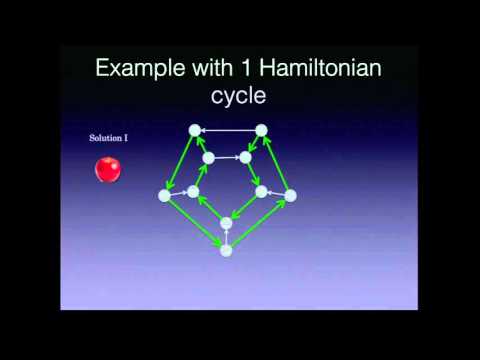
- 6:34Example with 1 Hamiltonian cycle
- 9:42Case in point
- 12:00A uniquely 3-colorable graph
- 13:06The connection
- 14:02An orientation with modular degree constraints
- 14:22Even subgraphs
- 16:18A non-3-colorable graph
- 16:45Even and odd subgraphs
- 17:18k-coloring and path decomposition
- 18:39k-coloring path decomposition hardness
- 19:19Bounded degree
- 19:54Counting subgraphs and path decomposition