Reinventing the File System: OpenZFS

summary
Presentation explains OpenZFS as a modern file system solution for storage challenges (hardware faults, caching, guarantees, performance, recovery speed, and ease of maintenance). It describes how OpenZFS addresses those problems while remaining free and easy to operate, discussing its features and practical benefits for high-load system storage.
AI-written summary · about
chapters (27)
- 0:00Introduction
- 1:54OpenZFS history
- 3:19ZFS features and tasks
- 4:25Filesystem comparison
- 5:08RAID controller issues
- 7:32Volume managers and LVM
- 8:55What is OpenZFS
- 9:59Pool and dataset management
- 10:43Dataset configuration
- 12:08Degraded mode operation
- 13:53Data atomicity and integrity
- 16:22Copy-on-write
- 18:29RAID 5 and power issues
- 19:55Checksums and self-healing
- 21:19Merkle trees and Git analogy
- 22:00Transaction groups
- 23:03Performance and fragmentation
- 25:07Performance tuning
- 26:11ZFS caching
- 27:15Data prefetching
- 28:17Data compression
- 29:00Integration and performance
- 29:43Community and development
- 30:46Feature flags and compatibility
- 31:51OpenZFS platform support
- 32:34Experiments and simplicity
- 33:17Q&A
related talks
 30mOpenZFS and Linux
 44mThe ZFS filesystem
 25mZonefs: Features Roadmap
 23mImproving data placement for Zoned Linux File systems
 18mExperiences implementing zonefs support in ZenFS
 31mFrom Open-Channel SSDs to Zoned Namespaces
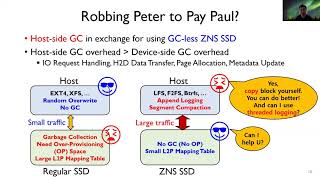 14mZNS+: Advanced Zoned Namespace Interface for Supporting In-Storage Zone Compaction
 17mHow advancements in storage are triggering innovations in open-source and vice-versa