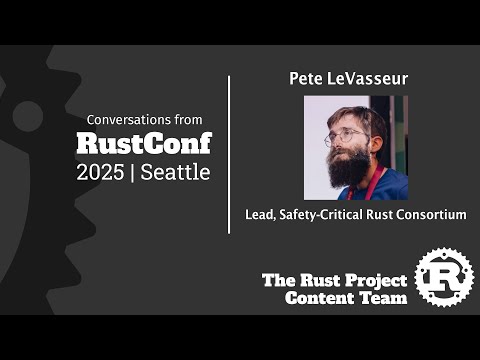
Pete LeVasseur, Lead, Safety-Critical Rust Consortium [Rust Project Content
summary
Overview gives concrete, actionable details: a consortium of about 150 individuals with subcommittees (coding guidelines ~50 members with 10–15 active, tooling ~30, liaison ~10) is building Rust rules, Clippy lints, and certification paths; work targets automotive ADAS with ASIL levels and examples like Eclipse uProtocol and medical monitoring deployments. It documents the need for a FLS maintenance cadence, a safety‑qualified compiler, tooling gaps such as MCDC coverage, and concrete next steps rather than vague promises.
AI-written summary · about
chapters (14)
- 0:00Safety-critical software intro
- 1:29Regulations and tiers in safety
- 3:56From assembly to Rust in automotive
- 8:53Safety-critical vs regular code
- 13:10Rust coding guidelines for safety
- 18:05Rust features complicating safety
- 21:58Rust language specification importance
- 28:00Safety regulations aren't bureaucracy
- 33:19Misra’s influence on Rust guidelines
- 37:11Rust in safety: current status and next steps
- 41:29Safety-Critical Rust Consortium community
- 44:19MCDC coverage for Rust
- 46:45Desires for Rust in safety
- 49:56Rust community values
related talks
 56mRust for Foundation Software
 07mLightning Talk: “How Rust Is Steering Automotive Software Toward Safety”
 22mRust as a Foundation for a Safe and Sustainable Future
 56mRust for Safe and Scalable Automotive: Insights from
 46mPanel: Rust in Safety Critical
 25mContinuous compliance with Rust in automotive software
 15mGold Sponsor Lightning Talks – Woven by Toyota
 08mOpening Remarks from the Rust Foundation