Modular Garbage Collectors in Ruby

summary
Experimental Ruby 3.4 modular GC exposes a C API (about 60 functions across 14 sections) by splitting GC.c into a VM interface and loadable GC implementations; the default GC becomes a shared library and MMTK (written in Rust) plugs in via C and Rust bindings. Current MMTK port implements no-GC, mark-sweep and non-moving Immix, builds with cargo, and runs slower than the default GC today; roadmap adds moving plans, generational support, and parallel work-packet execution.
AI-written summary · about
chapters (10)
- 0:00Introduction and speaker
- 1:28Ruby’s garbage collector overview
- 8:28Missing features in Ruby GC
- 14:31Motivation for modular GC
- 15:34Modular GC in Ruby 3.4
- 16:58Modular GC API explained
- 20:25Building Ruby with modular GC
- 20:46MMTK garbage collector
- 23:54MMTK integration with Ruby
- 27:04Conclusion and future
related talks
 30mBuilding the Next-Generation Garbage Collector in Ruby
 01h 03mMMTk and The Case for Modular VM Development
 30mBuilding the Next-Generation Garbage Collector in Ruby
 34mUnder the Hood of Ruby's Generational Garbage Collector
 40mMemory management with MMTk: lessons learned from replacing Ruby's garbage collector
 21mUnderstanding Garbage Collection in Ruby
 34mIt's dangerous to GC alone. Take this!
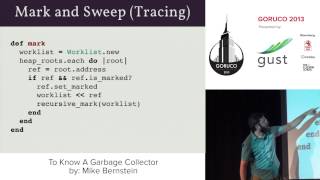 42mTo Know A Garbage Collector